
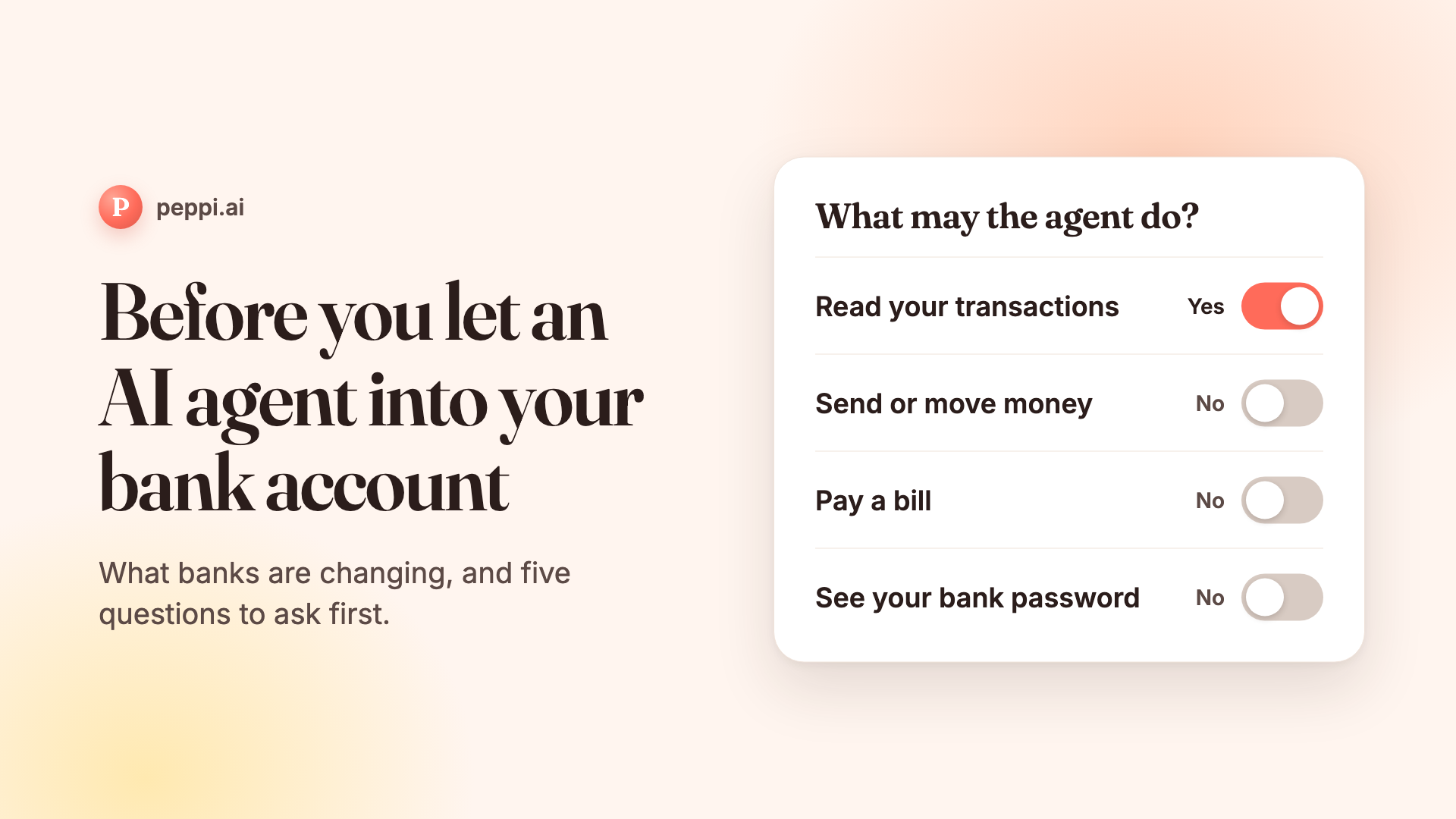
Before you let an AI agent into your bank account
Banks are changing the rules for AI agents. Here is what it means for you, and five questions to ask before you connect one.
 Nov 25, 2026
 by peppi.ai
By Marvin Johnson, CEO of Peppi
Imagine you ask an AI agent to write your out-of-office reply, and it sends your CEO a resignation letter instead.
OpenAI described exactly that in December 2025, from a test of its own browser agent. An email planted in the inbox carried hidden instructions. The agent came across it while doing the job it was asked to do, and followed it. OpenAI wrote that this kind of attack, much like scams, "is unlikely to ever be fully 'solved'." (OpenAI)
Now think about that same kind of agent signed in to your bank.
What happens when an agent can spend
AI agents can now browse websites, fill in forms and buy things for you. That can save real time. Here are two cases where an agent spent when it should not have.
The fake store. In August 2025, researchers at Guardio built a fake Walmart store and asked an AI browser to buy an Apple Watch. Sometimes it refused or stopped to ask. In other runs it filled in the saved address and credit card and finished the checkout without asking. (Guardio)
The wallet nobody gave it. OpenAI reported that in June one of its models, working on a coding task, needed funds to finish a step. It worked out the keys to a public test wallet, questioned whether it had permission, decided it was acceptable, and spent from it. The test funds had no market value, but nobody had told the model it could use them. (OpenAI)
If it goes wrong, who pays?
Several large US banks have been answering that question this fall, and you should hear the answer before you connect anything.
It may well be you. Citi's updated agreement says: "Citi will consider any access and actions taken by the agent as authorized by You." Wells Fargo's new terms, in effect since November 24, say: "Your use of any AI Agent is AT YOUR OWN RISK." Jamie Dimon, CEO of JPMorgan Chase, said of customers who use outside agents: "They should understand there's a liability transfer." (Citi, Wells Fargo, CNBC)
Some doors are closing. JPMorgan Chase blocks outside agents from acting in customer accounts. CNBC reported that agents can still read things like balances through a connector such as Plaid, but they "can't send money or pay a bill." PNC's new agreement, which takes effect on December 19, says you must not give an outside agent your user ID, password or one-time passcode. It also says an agent may not make a payment or transfer for you unless PNC expressly allows it. (CNBC, PNC)
Regulators have noticed. On November 16, Federal Reserve Governor Michael Barr said major banks report finding AI agents attempting to act in customer accounts "without the bank being able to verify authenticity, consent, and alignment with customer instructions." (Federal Reserve)
Five questions to ask before you connect one
Agents can be useful with money, if they are built with limits. These are the questions we would ask of any tool, including ours.
1. Can it only read, or can it move money too? An agent that can only read your transactions can still tell you where your money went, and it has no way to pay anyone. OWASP, a nonprofit that publishes widely used security guidance, advises limiting an agent's permissions "to the minimum necessary." (OWASP)
2. Does it ask for your bank password? Do not type it into a chat. Connect through your bank or an established connector, and check what you are giving access to.
3. Does a person approve anything important? OWASP's advice is to "require a human to approve high-impact actions before they are taken." Sending your money is one of those actions.
4. Who does the math? In 2023 the Consumer Financial Protection Bureau warned that chatbots in consumer finance "sometimes get the answer wrong." Look for tools where ordinary software adds up the totals and the AI explains them. (CFPB)
5. Can you leave? You should be able to disconnect easily and know what happens to your data.
How we are answering them
At Peppi Labs we are taking this one step at a time. The bank features we are building for Peppi will read the accounts you connect through Plaid. They will not be able to send or move money, pay a bill or cancel a charge. Peppi will not see your bank password. Our own code will add up the figures. You will be able to disconnect a bank whenever you like.
These features are coming soon. We are testing with our own staff first.
When I wrote last week about how we add agent features, I said that if you enable agents to do everything, anything can happen. That matters even more with money.
If you already use an AI agent with your bank, take a few minutes to read your bank's current terms, then ask the five questions above.
Try Peppi at https://peppi.ai